In a world filled with “fast furniture” and fleeting trends, have you ever looked at a neglected, old desk and seen more than just wood and dust? As an Admin of ReviewsMen.com with over a decade of experience in vanity tables, I’ve seen countless pieces transformed from forgotten relics into stunning focal points. This guide will take you through the rewarding journey of upcycling an old desk into a chic, personalized vanity table, blending functionality with unique style and sustainability. It’s an opportunity to create something truly special, perfectly tailored to your needs and aesthetic.
Why Upcycle an Old Desk into a Vanity Table?
Upcycling isn’t just a trend; it’s a smart, sustainable choice that offers numerous benefits beyond simply acquiring a new piece of furniture. Giving an old desk a new life as a vanity table allows for unparalleled personalization and contributes positively to both your wallet and the environment.
The Allure of DIY
|
Our Picks for the Best Vanity Table in 2026
As an Amazon Associate I earn from qualifying purchases.
|
||
| Num | Product | Action |
|---|---|---|
| 1 | SUPERJARE 35.4" White and Gold Desk with 2 Drawers, Modern Makeup Vanity with Padded Stool, Small Computer Desk Home Office Desk for Writing Study Bedroom |

|
| 2 | Black,Vanity Desk with Mirror and Lights,Makeup Vanity with Power Outlet and Adjustable Cabinet,Modern Makeup Table with 3 Drawers for Bedroom Makeup Room |
|
| 3 | Kitsure Vanity Desk with Mirror and Lights - Large Capacity Makeup Vanity with 4 Fabric Storage Drawers & 3 Lighting Modes, Vanity Table Set with Sturdy Metal Frame for Bedroom, White, 35" x 17" x 52" |
|
| 4 | Large Vanity Desk with 3 Color Touch Screen Dimming Mirror, Vanity Desk with Charging Station, Modern Retractable Makeup Dressing Table, Makeup Table With storage shelves and 5 Sliding Drawers, Walnut |
|
| 5 | 43" Fluted Makeup Vanity Desk with 32" Mirror and Lights, Modern Glass Top Large Vanity Table with 5 Drawers and 3 Storage Shelves, Dressing Table Set with Charging Station for Bedroom-Gray |
|
| 6 | Vanity Desk with 29.53" HD Lighted Mirror, 47.24" Big Modern Vanity Desk with Mirror and Lights, Makeup Vanity with 5 Drawers and Storage Shelves and Charging Station, Oak2 |
|
| 7 | 47.24" Big Modern Vanity Desk with Mirror and Lights,Makeup Vanity Desk with 5 Drawers and Storage Shelves & Power Outlet,Dressing Table with Glass Top, Oak |
|
| 8 | BOLUO Small Vanity Desk with Hollywood Mirror and Lights, Girls Vanity with Stool, Fluted Vanity Set, Compact Make Up Table with Drawers and Outlet Bedroom |
|
| 9 | Large Vanity Desk with 3 Color Touch Screen Dimming Mirror, Vanity Desk with Charging Station, Modern Retractable Makeup Dressing Table, Makeup Table With storage shelves and 5 Sliding Drawers, Black |
|
| 10 | 57“Makeup Vanity Desk with Mirror and Lights, Vanity Desk with 5 Drawers & Storage Shelves, Vanity Table with Power Outlet, 3 Color Modes & Adjustable Brightness Dressing Table, Bedroom,Oak |
|
There’s a unique satisfaction that comes from creating something with your own hands. Transforming an old desk into a custom vanity means you can dictate every detail, from the color palette to the organizational features, ensuring it perfectly matches your space and personal style. This hands-on approach results in a one-of-a-kind piece that store-bought furniture simply cannot replicate, infusing your beauty space with character and a personal touch.
Cost-Saving and Environmental Benefits
Opting to upcycle is significantly more budget-friendly than purchasing a brand-new vanity, especially if you find a desk for a bargain at a thrift store or already own one. Many old study or writing desks are often overlooked in today’s market, making them ideal candidates for transformation at a low cost. Furthermore, upcycling reduces waste by diverting furniture from landfills, lessening your environmental footprint and embracing a more circular economy.
Preparing Your Old Desk for Transformation
The foundation of a successful upcycling project lies in thorough preparation. Taking the time to properly assess, clean, and gather your materials will ensure a smooth process and a durable, beautiful outcome for your new vanity table.
Assessment and Cleaning
Start by closely inspecting your desk for any damage, loose joints, or missing pieces. Repair any wobbles with wood glue and clamps, and fill in deep scratches or gouges with wood filler, sanding them smooth once dry. Next, give the entire desk a thorough cleaning. A solution of vinegar and water works well for wiping down all surfaces, including crevices and drawer interiors, to remove dirt, grease, and grime. This step is crucial for paint adhesion and overall finish.
Essential Tools and Materials
Having all your tools and materials ready before you begin will streamline the upcycling process.
- Desk: An old wooden desk, preferably a study or writing desk style, or even a console table.
- Sanding: Orbital sander, sandpaper (various grits: 120, 180, 220, 240 grit).
- Repair: Wood filler, wood glue, nail gun or hammer and finishing nails, rubber mallet.
- Paint/Stain: Primer (like Zinsser B-I-N), chalk paint, mineral paint, or high-quality acrylic paint in your chosen color, clear wax or a durable topcoat (e.g., polycrylic, polyurethane, or a satin cabinet enamel for durability and smoothness).
- Application: Paintbrushes, smooth surface paint roller, lint-free cloths.
- Vanity Elements: Mirror (custom cut, vintage, or frameless), lift-up hinges (optional for a hidden mirror compartment), decorative hardware (knobs, handles, metal corner pieces), drawer organizers or scrap wood for dividers.
- Optional: Decorative appliques, stencils, decoupage paper, wood moldings, task lamp or LED strip lighting.
Step-by-Step Upcycling Guide
Transforming your old desk into a stylish vanity is a journey that unfolds in several key stages. Each step builds upon the last, ensuring a cohesive and professional-looking final product.
Repairing and Reinforcing
Address any structural issues first. Tighten loose screws, re-glue any separating joints, and use wood filler to mend any significant cosmetic damage like holes or deep scratches. If you’re modifying the desk’s structure, such as removing internal partitions or paper trays to create larger compartments, do so carefully with a rubber mallet. Reinforce any areas that feel weak.
Sanding and Priming
Sanding is a critical step for a smooth finish and proper paint adhesion. Start with a medium-grit sandpaper (120-180 grit) to remove any existing finish or imperfections, then move to a finer grit (220-240 grit) for a silky-smooth surface. If the desk has intricate details, hand-sand those areas. After sanding, wipe down the entire piece with a damp cloth to remove all dust. Apply a high-quality primer, especially if you’re painting a dark desk a light color or if the surface is glossy, to ensure even coverage and prevent bleed-through.
 An old wooden desk being sanded with an orbital sander and then primed with white paint.
Painting or Staining
Now comes the fun part: adding color! Choose a paint that is suitable for furniture, such as chalk paint, mineral paint, or a durable hybrid acrylic-alkyd formula, which offers excellent adhesion and a smooth finish. Apply thin, even coats, allowing each coat to dry completely before applying the next. If using chalk paint, consider its “no primer” claim, though a light sand is always beneficial. For a stained finish, ensure all previous coatings are thoroughly removed before applying your chosen stain. Once the paint or stain is dry, apply a protective topcoat like clear wax, polycrylic, or a satin enamel to enhance durability and protect against wear and tear.
Adding Key Vanity Elements
This is where your desk truly becomes a vanity.
- Mirror: Choose a mirror that suits your style and size requirements. A large, frameless mirror can be mounted directly to the wall or securely attached to the desk. Consider a vintage mirror for an antique look, or install a lift-up mirror with hinges if you’ve created a hidden compartment in the desk’s surface.
- Lighting: Proper lighting is essential for makeup application. Add an accent or task lamp, or integrate LED strip lights around your mirror for an even glow.
- Storage: Utilize the desk’s drawers by adding organizers or custom-built dividers using scrap wood to keep makeup and tools tidy. You can also line the drawers with decorative paper for an extra touch of elegance.
Personalizing Your Creation
Elevate your vanity with personal touches. Change out old hardware for new, decorative knobs or pulls that match your desired aesthetic. Add wood moldings or decorative appliques for a more ornate look, or try stenciling, hand-painted details, or decoupage paper on drawer fronts or sides for unique patterns.
Design Ideas for Your Upcycled Vanity
The beauty of upcycling lies in its versatility. You can adapt your desk to almost any interior design style, transforming it into a piece that truly reflects your personal taste.
Modern Minimalist
For a sleek, contemporary look, choose a desk with clean lines and paint it in a neutral color like white, grey, or black. Opt for simple, geometric hardware and a frameless mirror. Integrate subtle LED strip lighting and use clear acrylic organizers within the drawers to maintain a clutter-free aesthetic. The focus here is on functionality and understated elegance, with every item having its designated, organized spot.
Vintage Charm
If you appreciate the allure of yesteryear, select a desk with ornate details or interesting curves. Paint it in a soft pastel, a deep jewel tone, or a distressed white. Incorporate antique-style hardware, add decorative appliques or intricate stenciling, and pair it with a vintage-framed mirror. Consider a floral or toile decoupage on drawer fronts for an authentic touch. This style evokes a sense of timeless romance and sophistication.
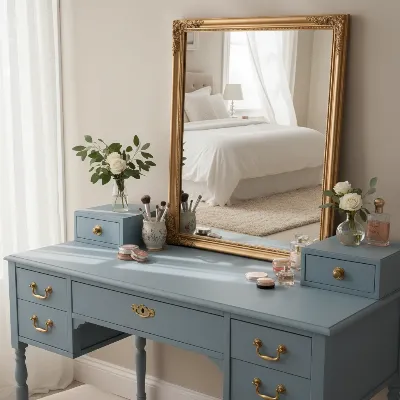 A beautifully upcycled vintage desk transformed into a vanity table with a soft blue paint finish, ornate gold handles, and a large, decorative framed mirror.
Bohemian Rhapsody
Embrace an eclectic, free-spirited vibe by painting your desk in a vibrant color or a mix of complementary hues. Incorporate textured elements like woven drawer pulls or macramé accents. A round, rattan-framed mirror or a collection of smaller mirrors can create an artistic focal point. Don’t be afraid to mix patterns and textures, using decorative fabric or wallpaper inside drawers. This style celebrates creativity, comfort, and global inspiration.
Maintenance Tips for Your New Vanity Table
Once your upcycled vanity table is complete, proper care and maintenance will ensure its beauty and functionality endure for years to come. A little attention goes a long way in preserving your hard work.
Daily Care
Wipe down the surface daily with a soft, damp cloth to remove makeup dust, spills, and fingerprints. For tougher spots, use a mild, non-abrasive cleaner. Always clean spills immediately to prevent staining, especially on painted or stained surfaces. Keep makeup brushes and tools organized in containers or drawer inserts to prevent clutter and damage to the vanity surface.
Long-Term Protection
To protect your vanity from direct sunlight, which can fade finishes, position it away from windows or use blinds. Avoid placing hot styling tools directly on the surface; instead, use a heat-resistant mat. If your vanity has a waxed finish, reapply wax every few months to maintain its protective layer and sheen. For painted surfaces with a polycrylic or enamel topcoat, occasional polishing with a furniture-friendly product can help maintain its luster. Address any minor chips or scratches promptly with touch-up paint to prevent further damage.
Conclusion
Upcycling an old desk into a chic Vanity Table is a deeply rewarding project that combines creativity, sustainability, and personal expression. From carefully selecting your desk to adding those unique finishing touches, each step allows you to craft a piece that truly resonates with your style and needs. Not only do you save money and reduce waste, but you also create a functional art piece that tells a story, making your beauty routine feel even more special. So, why settle for mass-produced when you can create a masterpiece? What unique story will your upcycled vanity tell?
Câu Hỏi Thường Gặp
What type of desk is best for upcycling into a vanity?
Ideally, a sturdy wooden desk with a flat surface and drawers is best. Old writing desks or study desks often have the perfect size and structure. The size should be at least 48 inches wide and 24 inches deep for ample surface area.
Do I need to sand the desk before painting?
Yes, sanding is crucial. Even if using “no-primer” chalk paint, a light sanding improves adhesion and creates a smoother finish. For glossy surfaces or when changing colors significantly, a thorough sanding followed by priming is recommended for the best, most durable result.
What kind of paint should I use for my upcycled vanity?
For durability and a smooth finish, consider chalk paint, mineral paint, or hybrid acrylic-alkyd formulas. Brands like Fusion Mineral Paint, Benjamin Moore Advance, or Behr Interior Satin Cabinet and Trim Enamel are highly recommended. Always choose a paint suitable for furniture.
How can I add lighting to my vanity?
The simplest way is to add a task lamp or two on the surface. For a more integrated look, attach LED strip lights around the mirror frame. Some DIYers even install vintage sconces on either side of the mirror for an even glow, enhancing functionality and aesthetic.
How do I organize the drawers of my new vanity?
Utilize drawer organizers, small containers, or even custom-cut scrap wood dividers to separate products by category. This keeps makeup, brushes, and tools neatly arranged and easily accessible, preventing clutter and maximizing the storage potential of your upcycled desk.
Can I change the hardware on the old desk?
Absolutely! Swapping out old knobs and handles for new, decorative hardware is a simple yet impactful way to update the desk’s look and match your chosen style. Ensure the new hardware fits the existing holes or be prepared to fill and re-drill.